Services > Mobile App Development > Android USA
Android App Development
Company in the USA
Android holds over 40 percent of the US smartphone market and more than 70 percent of the global market. For US businesses that need to reach field workers, logistics teams, healthcare staff, or a broad consumer audience across income levels and device tiers, Android is where the users are. Building for Android in the USA requires a specific kind of engineering discipline: the platform is fragmented across hundreds of device models and multiple active OS versions, the Play Store enforcement has become significantly stricter since 2024, and user expectations for performance on both budget and flagship hardware are higher than they have ever been.
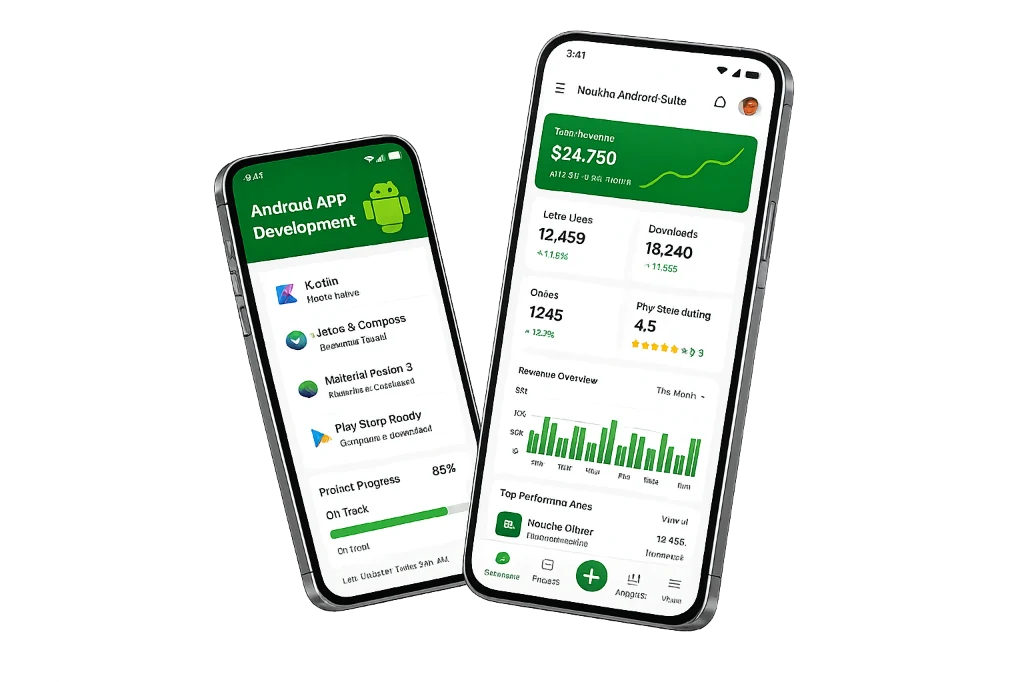
Noukha Technologies provides Android app development services for US businesses — native Kotlin applications built with Jetpack Compose and tested across the actual device matrix your users carry. We have shipped Android apps for US clients in logistics, healthcare, fintech, and field operations. If you need Android built properly by engineers who understand both the platform and the US market context, we can do that.
Recognized. Respected. Relied Upon.
Every rating below is based on verified client feedback from real projects — not agency-submitted profiles. Our Clutch rating of 4.9 and our GoodFirms listing reflect the consistency of what we deliver across Android and other mobile platforms.



Android in the USA: The Market Data That
Shapes How We Build
Building an Android app for US users without understanding the US Android market is how projects end up tested on the wrong devices, rejected by Play Store policies, or unusable on hardware your actual customers carry. Here is the market context we build against.
The US Android user base skews toward practical device use: field workers with Samsung Galaxy A-series devices, delivery drivers using Motorola and LG hardware, enterprise staff on managed Samsung or Zebra device fleets, and consumers on a wide range of hardware price points. An Android app built and tested only on a Pixel emulator will underperform on 60 percent of the devices your real US users carry. For context on overall mobile app development in the USA and how native Android fits into your broader platform strategy, see our full mobile guide.
Google Play Policy Compliance for US Android Apps
Google significantly tightened Play Store enforcement through 2024 and into 2025. For US businesses with existing Android apps or launching new ones, these changes have direct implications for what must be included in the app before submission.
Data Safety Section
Every app must complete Google's Data Safety section accurately. This declares what data your app collects, how it is used, whether it is shared with third parties, and what security practices are in place.
Target API Level Requirements
Google Play requires apps to target recent API levels. Apps that fall behind these requirements face Play Store visibility and publishing restrictions.
Background Permission Restrictions
Location, exact alarms, and nearby device permissions face additional scrutiny and require clear user justification during review.
Photo & Media Permissions
Android 13 and 14 introduced granular media permissions. Apps handling files or photos must follow the new permission architecture.
Health Data Compliance
Healthcare and fitness apps require additional declarations and compliance reviews, often intersecting with HIPAA obligations.
Play Store Readiness
Final compliance checks, policy validation and release preparation before submission.
Our Android App Development Services in the USA
Native Android using Kotlin and Jetpack — from architecture through to a live, Google Play-approved app. As a mobile app development company in the USA, Android native is one of our core delivery tracks.
Native Android Development with Kotlin
We write Android apps in Kotlin using Jetpack Compose for the UI layer. Kotlin is Google's preferred language for Android and produces safer, more concise code than Java. Jetpack Compose replaces the XML view system with a declarative UI model that is faster to develop and easier to maintain.
Material You Design for US Brands
Material You (Material Design 3) is Google's current design system for Android, introduced with Android 12. It supports dynamic colour theming, updated typography, and adaptive layouts. We implement Material You as the baseline for all new Android projects, with brand customisation applied on top.
Jetpack Architecture Components
We use the full Jetpack suite: Room for local database persistence, ViewModel and LiveData for lifecycle-aware state management, Navigation Compose for in-app routing, WorkManager for background tasks, and CameraX for camera access. This is the recommended Android architecture and what Google Play reviewers expect to see.
Google Play Store Submission
Complete submission: Data Safety section, app metadata, screenshot optimisation for US English, APK/AAB signing, and the review process. We have strong first-submission approval rates and handle the back-and-forth with Google's review team if any policy clarification is required.
Android Backend and API Integration
RESTful and GraphQL API integration. Firebase (Realtime Database, Firestore, FCM, Analytics, Crashlytics). AWS Mobile SDK. Stripe, PayPal, Google Pay for payments. Google Maps Platform for location features. All integrations typed with Kotlin coroutines for non-blocking network calls.
Android App Maintenance and Updates
OS compatibility testing for each new Android major release. Jetpack library dependency updates. Google Play policy change management. Security patch handling and ProGuard/R8 optimisation. Available on monthly retainer or incident-based SLA contracts for US clients.
Android Apps for Every US Industry
The Android platform serves a wide range of US business contexts — from consumer apps to enterprise field tools. Our industry experience shapes how we architect and test every Android project we take on.
Logistics and Field Operations
Android field apps for US logistics businesses: offline-first with Room database, barcode and QR scanning via ML Kit, background GPS tracking via Fused Location Provider, and proof-of-delivery capture. Tested on Zebra enterprise devices and Motorola consumer hardware.
Healthcare and Clinical
HIPAA-compliant Android apps: PHI encrypted with AES-256 at rest, secure network calls with certificate pinning, biometric authentication via BiometricPrompt API, and audit logging. For US clinical staff using managed Android device fleets.
Fintech and Payments
Android payment apps with Google Pay integration, NFC payment support, Plaid KYC, and PCI DSS-aligned tokenized transaction flows. Multi-factor authentication via Android Keystore. For US fintech startups and NBFC-equivalent businesses.
Retail and E-Commerce
Native Android shopping apps with RecyclerView optimised product lists, Google Pay checkout, real-time inventory management, and push notifications via FCM. A/B testing via Firebase Remote Config to optimise US consumer conversion funnels.
Manufacturing and Industrial
Android apps for US manufacturing operations: ERP integration via custom REST APIs, quality inspection checklists, shift management, and offline-capable production reporting for factory floor environments.
Education and EdTech
Android LMS apps with offline content access via Room and file system caching, video delivery with ExoPlayer, quiz and assessment engines, and progress tracking. For US EdTech companies targeting students on Android devices.
SaaS and Enterprise
Android mobile extensions of US SaaS platforms: SSO via SAML/OAuth, role-based access control, Salesforce and HubSpot deep links, and the enterprise mobile management (EMM/MDM) compatibility that US IT procurement requires.
Food Technology
Android ordering apps with GPS-based delivery tracking, kitchen display integration, driver dispatch management, and loyalty programme backends. For US restaurant chains and food delivery businesses.
Real Estate and PropTech
Android property search apps with Google Maps Platform integration, AR measurement features via ARCore, lead management workflows, and e-signature via DocuSign SDK for the US real estate transaction process.
Our Android App Development Process
for US Clients
Every Android project at Noukha follows the same structured delivery process.
Milestones are tied to working, testable APK builds — not status updates or slide decks.
For Flutter app development in the USA or iOS app development in the USA, the same process applies with platform-specific tooling.
01 — Android Architecture and Scoping
Step 01We scope the Android project against your US market requirements: target device matrix, minimum Android version, offline requirements, compliance obligations, and Play Store policy implications. The output is a written proposal with a fixed price or T&M estimate, an itemised milestone schedule, and a Kotlin/Jetpack architecture overview before any commitment.
02 — Material You UI/UX Design
Step 02We design specifically for Android using Material Design 3 guidelines. Dynamic colour theming, edge-to-edge displays, predictive back gesture support, and the adaptive layouts required for Android's wide range of screen sizes and foldable devices. You approve an interactive prototype before the first Kotlin sprint.
03 — Kotlin Sprint Development
Step 03Two-week Kotlin sprints. Every sprint delivers a real APK you can install and use — not a written update. US clients get real-time access to the sprint board and weekly async progress notes between synchronous reviews.
04 — Android Device Testing
Step 04Real-device testing across our Android test matrix: Google Pixel, Samsung Galaxy A and S series, Motorola G series, and relevant enterprise devices. Automated testing via Espresso and UI Automator, supplemented by manual testing on every device tier. Play Store pre-launch report review before submission.
05 — Play Store Launch and Maintenance
Step 05Complete Play Store submission including Data Safety section, store listing optimisation, and the review process. Post-launch: Firebase Crashlytics monitoring, ANR resolution, ProGuard optimisation updates, and annual Android OS compatibility testing. SLA contracts or monthly retainer options for US clients.
The Technology Stack Behind Every Noukha Android App
Complete Android ecosystem — every layer we use for scalable US mobile applications.
Kotlin & Modern Android
Kotlin 1.9+ powers all modern Android development at Noukha. Coroutines and Kotlin Flow provide scalable asynchronous programming, cleaner code, and highly responsive user experiences.
Jetpack Compose UI
Jetpack Compose and Material Design 3 allow us to build highly responsive Android interfaces. Navigation Compose and Accompanist streamline navigation, animations, and adaptive layouts.
Scalable Android Architecture
We follow MVVM combined with Clean Architecture to keep Android applications maintainable and scalable. Hilt, ViewModel, LiveData, and StateFlow help create predictable application behaviour.
Offline Data & Persistence
Room Database, DataStore, EncryptedSharedPreferences, and SQLite enable secure local storage, offline-first experiences, and reliable data synchronization.
Networking & API Integration
Retrofit, OkHttp, Moshi, Gson, and Apollo GraphQL provide robust communication layers for REST APIs, GraphQL services, and enterprise backend integrations.
Analytics & Mobile Services
Firebase powers crash monitoring, push notifications, analytics, and feature rollout strategies. We use Crashlytics, FCM, Analytics, and Remote Config extensively in production apps.
Camera & Computer Vision
CameraX, ML Kit, and ARCore enable barcode scanning, text recognition, face detection, augmented reality features, and advanced camera-driven workflows.
Payment Integration
We integrate Google Pay, Stripe, PayPal, and Braintree to support secure checkout flows, subscription billing, and enterprise-grade payment processing.
Maps & Location Services
Location-based applications leverage Google Maps SDK, Geofencing APIs, and Fused Location Provider for navigation, tracking, logistics, and field-service solutions.
Quality Assurance & Testing
Our Android QA process includes Espresso, UI Automator, JUnit 5, Mockito Kotlin, and Robolectric to ensure stability across devices, operating systems, and release cycles.
Deployment & Release Automation
GitHub Actions, Fastlane, Firebase App Distribution, and Play Console APIs automate testing, build generation, internal distribution, and production releases.
Android App Development Cost for US Clients
Android project costs at Noukha are structured around scope and complexity, not arbitrary tiers. These ranges are based on real Android projects we have delivered for US clients.
Android Starter
8 to 12 weeks | Android only
Android Business App
12 to 16 weeks | Android
Android Enterprise Platform
Custom | Dedicated Android squad
Frequently Asked Questions
The Android-specific questions US businesses ask most before starting a native Android project.
Let’s Build Something Great Together
Looking to build a custom software solution, AI product, or digital platform? Use the form below to tell us about your project. Our team will respond within one business day.
Please share a few details. A team member will get back to you within one business day.
From our offices in the UK, India, and Canada, we work with clients across borders to deliver reliable software solutions.